Showing posts with label how to drive in the snow. Show all posts

Thursday, January 18, 2018

5 Ways to Get Your Car Out of the Snow

car stuck in snow
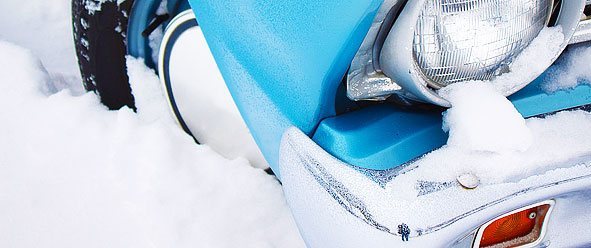
Getting stuck in the middle of a big pile of snow or on a stretch of ice can be an all-too-common occurrence during the cold winter months. Luckily, we have a few tips and tricks that can get your car free in no time, even if you don’t have one of the best vehicles for winter driving. Here are some things you can try if your car is stuck in snow:

1. Clear a path around your tires

Try to dig snow and ice away from the drive tires. You want to free up a few feet in front of and behind the tires so you can move the car back and forth. Also, dig out any snow under the front or middle of your car that is higher than its ground clearance.
Of course a shovel makes this much easier, so try and store one in your trunk along with some other winter emergency items if you plan on driving in snowy conditions.

2. Rock your car free of the snow

Carefully switching from drive to reverse can help dislodge some of the snow around your wheels. “You go into drive, then reverse, then repeat,” says Mark Osborne, who oversees Michigan Technological University’s Winter Driving School. “But you have to be careful not to wreck your transmission. I put my foot on the brake at the peak of each ‘rock,’ so the car is motionless when I change gears. It’s also helpful to shift to neutral for a second before making the transition.”

3. Don’t floor the gas

You’ll always be tempted to floor it if you’re stuck. But don’t. Go easy on the pedal to give the vehicle just a little gas for a moment, then let off. Repeat to enhance the needed “rocking” motion. It’s momentum that sets you free, not power.

4. Improve traction

If you still can’t get your car free, you can next try and improve traction under your wheels. Things such as sandbags, salt, dirt or even kitty litter can be used when your car is stuck in snow. Throw several handfuls under your tires for improved traction, then try the gas again.

5. Get others to help push your car

If you have other people in your car, or friendly onlookers who can help, simply pushing your car out of the snow can be an easy solution. Gently press the gas while the car is being pushed to add additional momentum. Safety always comes first, so make sure you’re in forward gear and the ground isn’t too slippery for helpers to push.

Always keep a cool head

Whether you’re stuck in snow or hit a stretch of ice, try and remain calm. Don’t do anything abrupt, like slamming the brakes. “If you do that, you’ll transfer your vehicle’s weight to your front wheels,” Osborne says. “That lightens up the rear, making it likely that your rear end will spin.” Instead, Osborne says, gradually let off the gas and hold the steering steady until you’ve cleared the ice.
If all else fails, an emergency roadside assistance service can give your car a tow. Learn more about the benefits of our Roadside Assistance program here.
Your car getting stuck isn’t the only concern when winter comes along. Snowy and icy pavement can lead to accidents. To help you navigate inclement weather this winter, check out our safety tips for driving in a snowstorm.

Tuesday, December 19, 2017

5 Car Features to Protect You on Winter Roads

With nearly 70 percent of the nation’s roads in snowy regions, the majority of Americans have had a “white-knuckle” driving experience in their past. Winter roads claim the lives of 1,300 people every year and injure 116,800, according to the U.S. Department of Transportation.
Fortunately, new features including forward collision alerts and lane departure warnings, are protecting Americans on slick roads. The impact of these new safety features has been substantial.
Vehicles made after the year 2000 helped to prevent 700,000 crashes, saved the lives of an estimated 2,000 people annually and kept one million people safe from injury, according to a report conducted by the National Highway Traffic Safety Administration.
“There’s no question, vehicles are safer today than they were a decade or two ago,” says Phil Marzolf, manager of i25 Kia outside of Denver. “Consumers are embracing new features that provide additional safety during bad weather conditions.”
An increasing number of new vehicles are now equipped with these five technological safety advances:
5 Car Features to Protect You on Winter Roads [Infographic]
Provided by Nationwide

1. Forward collision warning and auto-braking

Vehicles can sense hazards in the road, warn the driver and brake the car to prevent a crash. If a driver is following someone who slams on the brakes, for example, a combination of sensors, laser beams and cameras detect the problem and alert the driver. Assistive technology automatically applies the brakes to prevent a crash. The driver resumes control as soon as he or she applies pressure to the brake.
“It’s amazing technology,” Marzolf says. “In most cases, the technology senses the problem before the driver does. Even if it engages the brakes a second sooner, it could save a driver’s life.”

2. Lane departure warning system

Keeping drivers in their respective lanes on slippery roads is essential to highway safety. If a car starts to drift into another lane, the driver is alerted to the hazard by a buzzer, warning light or vibration. Assistive technology will start to correct the problem, slowly moving the car back into the proper lane (though the technology does not work when snow covers lane markings). The driver resumes control as soon as he or she starts to make the correction.

3. Adaptive headlights

Visibility can be an issue on winter roads. Traditional headlights shine straight ahead, but adaptive headlights react to the steering wheel. If a driver turns the wheel to the right, the headlights follow to increase visibility.
“It sounds like a simple feature, but adaptive headlights can really help drivers follow the road,” Marzolf says.
Insurance companies have noticed a 10 percent drop in the number of property damage liability claims in cars that have adaptive headlights, according to a study conducted by the Highway Loss Data Institute.

4. LED taillights

When snow is falling, spotting taillights ahead can be a trying task. Halogen light bulbs were the standard, but now more manufacturers are moving to LED bulbs, Marzolf says. LED bulbs outshine halogen bulbs, which gives winter drivers an edge when visibility is low.
“All the vehicles we sell have LED lights now,” Marzolf says. “Again, it’s a small change but one that gives drivers added security.”

5. Traction control

In slippery conditions, tires can lose traction and spin. The traction control feature helps tires grip such slippery roads, Marzolf said. In wet conditions, tires can lose traction and spin. Traction control uses sensors to measure rotational speed in tires and triggers the engine to adjust the level of power the vehicle needs to regain control. If needed, the sensors can pump the brakes to keep the driver from losing control.

More features become standard

Traction control and LED taillights are already becoming standard features in most vehicles, which means there isn’t an added cost for them. In time, Marzolf expects, the assistive-driving features will become standard as well.
“There was a time when anti-lock brakes were new,” he said. “Now, they’re an afterthought, and they have been standard in cars for some time. We’re not there yet, but I do expect assistive-driving features to become just as standard as anti-lock brakes.”
Currently consumers have to pay extra for assistive-driving features. These features could add $1,800-$4,500 to the price tag of a new car, according to Marzolf and AutoTrader.com.
“The added cost is sometimes a problem, but we’ll see reductions in time,” Marzolf says. “In the near future, I think drivers will embrace these tools and be glad they have them at their disposal on winter roads.”