Monday, May 1, 2017

Pet Insurance Buys Peace of Mind for Dale Earnhardt Jr.

Pet Insurance Buys Peace of Mind for Dale Earnhardt Jr.

Dale Earnhardt Jr. and his dog.
As Nationwide’s current ad campaign highlights, Dale Earnhardt Jr. knows how important it is to insure and protect his “many sides” including his car, his small business, and his home. He takes that same protective approach to his beloved pets.
“Pets are great, because they’re another personality in the house,” he says. “They like to do things with you. Wherever you’re at, that’s where they want to be. I think we humans appreciate that affection and camaraderie.”
In addition to enjoying his dogs’ companionship, Earnhardt says part of his responsibility as a “pet parent” means keeping them healthy. Junebug, a Pomeranian, and Gus, an Irish Setter, are so much a part of the family that they even get to travel with him and wife Amy.
“They like to go to the beach, or anywhere there’s a lot of grass for them to run around on,” he says, adding that even when he’s traveling for work, they can find a place for the dogs to play.
“Some of the tracks we go to have fenced-in areas and dog parks nearby where they can play.”

Healthy = Happy

Maintaining good health in both dogs is a priority in the Earnhardt household. Both he and his wife, Amy, make sure that proper diet, exercise and veterinarian visits are part of the routine.
“Amy has a special food that she gets from the vet, and we take [the dogs] to the vet quite regularly, any time we notice something isn’t quite right,” he says. “They’re always around us and we play with them a lot, so we can tell when they’re not feeling well. We really try to stay on top of that.”
That’s where pet insurance can come in handy, he says, by helping defray costs of visits, treatments and, in case of a more serious disease, it can help cover the cost of surgical procedures.
“I had an 11-year-old Boxer named Killer [who got cancer] and we were hoping it was treatable, but it wasn’t,” Earnhardt recalls. “His treatment was very expensive. Having pet insurance gives me peace of mind, knowing if something like that happens, we have it covered.”
While he has loved all of the pets he has had throughout his life – everything from hamsters, cats, dogs and even a rabbit – he says that the bond he has with Gus is unlike any other he has experienced.
“My connection with him is stronger than any pet I’ve had,” he explains. “Keeping him healthy and safe is so important to me, and having pet insurance is critical to that.”
If you’re a pet owner, make sure you have a plan in place to protect your pet’s health and safety. Learn more about the benefits of pet insurance.     

Friday, April 21, 2017

5 Things That Can Affect Your Auto Insurance Rates


car insurance premiums


Sometimes when people change something about their lives, they are surprised to find out their insurance rate changes, too. This is true with car insurance, as insurance companies use many factors to price auto policies.
Knowing what some of these factors are, and why they matter to insurers, can help you better understand rate changes, if they occur.
Here are five reasons an existing insurance policy rate might rise or fall in price.

1. Car type

Different types of cars cost differing amounts to insure. That’s because some cars have more safety features than others and, statistically, those driving in cars with more safety features have less severe physical injury claims and, therefore, require less medical care. These features might also mean these drivers have fewer accidents because the safety features might help prevent them. When claims occur, though, repair costs may be higher if safety features get damaged. If you’re thinking of getting a different car, it’s helpful to call your insurance agent first, to find out how that car model will affect the insurance rate.

2. Change of residence

Even if your new home is only a block away from your previous address, if it’s in a different zip code, your auto insurance rates could change. Zip codes are one factor insurance companies may use to set rates. The claims within each zip code might have a different number of auto accidents, thefts, vandalism, fraud and other issues affecting claims. Auto policies vary in price from state to state as well. That might be attributed to accident rates, but it also can be from state laws mandating what insurance companies must cover.

3. New driver on the policy

Adding someone to your auto policy will also affect the rates. If the new person on the policy is a teen driver, some parents are surprised to see their monthly premiums increase. This is because teens in their first six months of driving independently have more crashes than in their next year of driving, according to a study by the National Institutes of Health and the Virginia Transportation Institute. As teens gain experience behind the wheel, they have fewer accidents. Still, because teenagers have a statistically higher incidence of auto accidents, the group is more expensive to insure. Check out these seven tips to make your teen a better driver.

4. Vehicle’s age

While it’s true some cars become more valuable (if kept in mint condition), most vehicles do not. The good news is that as cars get older, they may cost less to insure. One factor insurance companies use to set rates is the cost to repair a damaged car or the value paid to a policyholder for a car that’s beyond repair. If an insurance company decides to pay an older car’s cash value instead of repairing it, that’s usually less expensive than paying the cost of a newer car.

5. Accidents and violations

After an accident or moving violation, insurance rates sometimes increase. That can happen even if the accident is not the insured’s fault. Some companies, including Nationwide, offer Accident Forgiveness coverage in certain states. With this coverage option, your premium won’t increase after your first at-fault accident. Sometimes policyholders can also get auto insurance discounts if they’ve gone through a period with no accidents or violations.
It’s helpful to check with your insurance agent to ask about the factors that affect your car insurance policy. If you’re looking to get a new car, it’s also a good idea to ask us how the different models you are considering will affect your insurance rate.
Learn more about the price of auto insurance – it can help you estimate your budget and maybe even help you save money.

Tuesday, April 18, 2017

Landscaping Ideas on a Budget


6 Backyard Landscaping Ideas on a Budget


1

cheap backyard ideas
Low-budget landscaping needn’t be bare-bones. A little money and effort can create a big impact regardless of how much space you have.
Before starting your backyard renovation, have a design in mind. It’s easy to be wooed by beautiful blooms at nurseries. If you have a plan, you’re more likely to purchase the right plants and know where they should go. Here are some backyard landscaping ideas that can spruce up a yard on any budget.

1. Invest in soil

“Soil amendments and preparation – raking, tilling and grading – are the most important aspects of budget gardening,” says landscape architect Eric King. Plants grow better in improved soil, so you can start with smaller, cheaper plants rather than larger, more expensive ones.
To stretch your plant budget further, shop wholesale nurseries and end-of-blooming-season sales. Focus on perennials that can overwinter in your climate zone (so you don’t have the cost of planting each year) and that provide year-round interest through color or texture. You can add bright pops of color throughout the year with a few potted annuals.

2. Employ dimensional design

Even budget-friendly backyard landscaping ideas should include plants of various heights and textures for visual depth. Designing vertically, for instance, makes a small space seem larger and more interesting, so you get more style and function for your money. Ensure plants aren’t all one height, though.

3. Pick low-maintenance foliage

Include bushes and ornamental trees in your landscape design, too. These options add interest for decades, without the need to replant, thus saving money long-term. Slow-growing Japanese maples, for instance, add height, color and, in winter, architectural interest. Ornamental grasses add low-maintenance texture and eliminate the need to replant seasonally with flowers. Non-woody vines, like jasmine on fences or walls, add dimension and draw the eye upward. Woody vines like honeysuckle and bougainvillea, in contrast, are best suited for pergolas and other well-ventilated structures, because they trap moisture beneath their leaves, which contributes to wood rot. Vines can quickly fill in barren areas, providing extensive coverage at relatively little expense.

4. Create a destination point in your yard

Even if you have a tiny yard, you can create a destination point. A seating area and a garden feature, like a reflecting ball that’s separated from the rest of the lawn, are two examples. Budget-friendly options include refurbished and repurposed garage sale finds like retro-aluminum chairs and construction elements like salvaged windows or newel posts. If you’re handy, build your own seating after a trip to the home-supply store. Access your special area with a winding path that invites walkers to slow down and enjoy the changing views.

5. Set up a “secret room”

Mobile plantings can make the garden room multifunctional. Says landscape designer Chris Lambton, host of HGTV’s “Going Yard” series: “Using planters on casters lets you create a secret room with plenty of greenery but gives you the flexibility to easily move plants out of the way to repurpose the area for dining or entertaining.”

6. Consider alternatives

For paths or patios, natural stone or pavers are a good investment if you plan to stay in the home a while. On the other hand, “pea gravel or crushed stone can make a fabulous surface for much less money than mortared flagstone or pavers,” King says. If you choose stone or pavers, however, you can still save money by not mortaring them in place.
To install pea gravel, stone or pavers, remove any existing turf from the area and put down a layer of landscaping fabric to minimize weeds and to prevent the gravel from being pressed into the soil. You can add the pea gravel on top of the fabric. For stone or pavers, cover the fabric with sand for easy leveling. Soften the look by planting grass or creeping plants like elfin thyme or Irish moss in the spaces between the stones.
Improvisation is integral to low-cost landscaping ideas. If, for instance, replacing an unsightly fence isn’t feasible, screen it with reed or rolled bamboo. Repaint faded plastic planters using plastics paint from any home store. If your patio slab is broken, cover it with a layer of pea gravel.
Low-cost backyard renovations can be exciting and fun. Using your ingenuity to find the best deals and your creativity to employ a variety of materials can transform your yard from dreary to dynamic – even on a tiny budget.
Renovating your backyard can increase your home’s property value, too. Make sure you have the right coverage for your home and backyard, get a home insurance quote today.

Monday, April 10, 2017

How to Buy Life Insurance: a Guide


Purchasing life insurance is often a good decision. It protects your family financially when the unthinkable happens. Peace of mind for the future of your family requires some research and taking a few steps to find the best life insurance policy for your needs.
So, how do you buy life insurance? We break down the ways to get life insurance below.

Getting life insurance from your employer

Many employers offer group life insurance as a company benefit, whether they pay the entire premium or subsidize it. In fact, group life insurance represented 43% of all U.S. life insurance policies in 2014, according to the American Council of Life Insurers.
There are several advantages to these policies. If the company pays all or most of the cost, that’s, of course, a monetary savings for employees. However, the amount purchased may not meet your ultimate needs. If the benefits equal one or two times your salary, that’s probably not enough to leave your family in a comfortable financial position should you unexpectedly pass. You may have the option to upgrade the policy to a higher amount by paying the difference, or you can use this policy as a secondary one, purchasing an individual policy elsewhere.
One huge upside to group life insurance is you don’t usually have to take a medical exam to get it. It is easier to obtain group life insurance in these situations than as an individual.
The downside to getting life insurance through the employer is the coverage usually ends when employment ends. If you leave your job, whether you’re laid off or proactively find a new one, your life insurance policy doesn’t come with you. You might be able to convert it to an individual policy, but the costs may be higher than one acquired on your own. While a new employer might also offer life insurance benefits, there may be a waiting period.

Getting life insurance independently

If you want to buy life insurance independently of your employer, you can go to a specific insurance carrier or an online broker that sells policies from different companies. If you know what kind of insurance you want, you can get quotes online or with a phone call.
The advantage to getting online or phone quotes is you can get pricing information quickly and then compare quotes. If you go that route, it’s helpful to have a strong insurance background because you won’t be getting as much guidance as you would through your personal insurance agent. You might be comparing policy options without understanding the differences.

Talk to an insurance agent

Calling or meeting with a personal insurance agent is another way to get life insurance. Some insurance companies offer discounts to customer who bundletheir policies, like having homeowner, auto and life insurance all with the same carrier.
The advantage to using personal insurance agents is they already understand your financial needs and they care about you as a long-term customer. They’ll spend the time to discuss the various life insurance types so you can find the best one for you. The disadvantage to using your personal agent is that they may be tied to only one insurance carrier, so they may not be able to offer you life insurance options from other companies.

What’s next?

Once you’ve chosen the policy you want and gotten a quote, you’ll apply for the insurance. That involves speaking with an insurance agent, even if you got your quote online. The agent will ask some questions and discuss the policy you chose. The agent will also send you paperwork to fill out and sign.
It’s likely that you’ll need a medical examination as the next step. The company will contact you to set up a time. The examiner will come to your home or office for some basic testing, such as determining your weight, getting a blood sample, perhaps an EKG, and listening to your heart.
This entire underwriting process can take a few weeks. Assuming everything checks out, the insurance company will send you the policy approval and ask for payment, if you haven’t already given a deposit. The premium might be different than in the original quote, depending on the results of your  medical exam and risk category.

Thursday, March 9, 2017

2 in 3 Small Businesses Lack a Written Disaster Recovery Plan


Nebraska-based seed dealer Dan Oswald never expected rare twin F4 tornadoes to tear through his small rural town in 2014 and destroy his business.
But because Oswald was properly insured through Nationwide with the help of his independent agent, his insurance claim was processed before the governor even landed to declare a state of emergency. Since then, Oswald has rebuilt and increased the square footage of his facility by 66 percent.
“I knew what a tornado could do, but you never think it would hit your place,” Oswald said. “I didn’t even recognize it. Indescribable. You don’t know what street you’re on or what you’re looking at because you don’t have any landmarks or anything in your memory that tells you where you’re at. I think you kind of go into shock a little bit. But two days after the tornado, I had a check in my hand.”
Oswald represents one of more than 100,000 commercial catastrophe claims that Nationwide has processed since 2007. While the number of claims has fluctuated over the past decade, the severity has increased steadily.
Nationwide has seen a 26 percent increase in the average severity of commercial catastrophe claims when comparing the three-year period between 2014-2016 with the seven-year period between 2007-2013. The company has also seen a 14 percent increase in unique commercial catastrophe events that impact a business when comparing those same time periods.
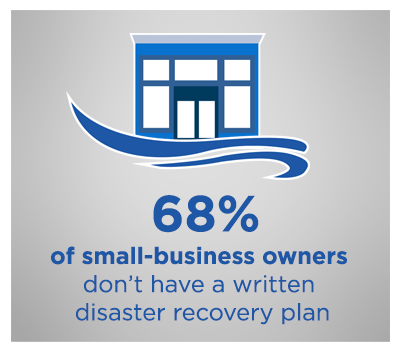
Despite those statistics, most small-business owners (68 percent) still don’t have a written disaster recovery plan — even though about half (49 percent) said it would take their business at least three months to recover from a natural disaster.
Those findings stem from Nationwide’s second annual Small Business Indicator, which was conducted online by Harris Poll on behalf of Nationwide from June 10-23 among 502 U.S. small-business owners with fewer than 300 employees.
“Small-businesses owners are crucial to our economy,” said Mark Berven, president of Nationwide Property & Casualty, the No. 1 total small-business insurer[1] in the country. “And they are often the ones impacted the most by a disaster. That’s why it’s so important for people to start preparing now — especially as we head into the spring storm season.”
Nationwide’s survey revealed critical gaps in disaster preparedness for small businesses:
  • 71 percent of small-business owners don’t have business interruption insurance, which can be vital to survival since an estimated 25 percent of businesses never reopen following a major disaster[2]
  • 21 percent of small-business owners without a written disaster plan said they don’t have one because it’s not a high priority for them
  • 22 percent of small-business owners have already been impacted by a natural disaster
While most small-business owners don’t have a formal plan, many have taken various steps to prepare for a natural disaster. The majority reported that they can work remotely in case of a natural disaster (82 percent), have duplicated and stored their company’s vital records off site (75 percent) and have access to alternative suppliers (78 percent).
For tips on creating a disaster recovery plan, check out the Insurance Institute for Business & Home Safety or Nationwide’s Business Interruption Insurance page.
 Methodology
The Small Business Owner Study was conducted online by Harris Poll on behalf of Nationwide from June 10-23, 2016. Respondents comprised 502 U.S. small-business owners of companies with less than 300 employees, and included 284 small-business owners who do not have a written disaster recovery plan. Results are weighted to be representative of small-business owners in the U.S. Research participants were drawn from the Harris Poll Online (HPOL) research panel and partner sample. Because the sample is based on those who were invited to participate in the HPOL panel, estimates of theoretical sampling error cannot be calculated. Percentages were rounded to the nearest whole percent.
[1] Conning, 2014; Conning Strategic Study: The Small Business Sector for Property-Casualty Insurance: Market Shift Coming.
[2]Source: Insurance Institute for Business & Home Safety.

20 Spring Cleaning Hacks to Simplify Your Life

Spring has arrived – which means it’s time to get your home in shipshape. Check out the creative spring cleaning tips and tricks below to make your house sparkle with the least amount of elbow grease.

1. Remove water stains with lemon halves.

Make faucets sparkly clean by rubbing a lemon half on the stains. The citric acid helps remove hard water marks.

2. Organize your fridge and cabinets with rotating turntables.

Rotating turntables and Lazy Susans don’t have to be limited to your tabletops. After discarding old condiments and spices, organize your pantries and refrigerator with this useful storage hack.

3. Use coffee filters to clean screens.

Does your TV screen or computer monitor show fingerprints, smudges and dust? The fiber in coffee filters may be gentle enough to rub them away.

4. Clean dirty keyboards with cotton swabs.

Cotton swabs can clean more than just your ears. Use them to sweep the dust and grime lodged between the keys on your computer keyboard.

5. Cover your showerhead with a plastic bag containing white vinegar to remove buildup.

Mineral deposits accumulate in showerheads over time, causing reduced pressure and water flow. Fill a plastic bag with white vinegar, secure it over the showerhead with a rubber band and leave it overnight to get rid of buildup.

6. Use a butter knife to clean air vents.

Don’t let that dust build up for another minute. Use a butter knife for easy access. Simply wrap the knife in a rag and wipe between the crevices of the vent.

7. Unpack and stack your spring/summer clothes vertically.

Are your dresser drawers a mess? Instead of putting away folded clothes flat, stack them vertically for easy access.

8. Use cream of tartar to clean toasters and tea kettles.

Combine 1 tsp of cream of tartar with just enough water to create a milky paste. Rub the solution onto your stainless steel appliances and wipe away to reveal their original shine.

9. Clean stainless steel sinks with baking soda.

Simply wet your sink and faucet, sprinkle baking soda, and scrub with a sponge. If you need more heavy-duty scrubbing power, add salt to the baking soda.

10. Wrap a towel over a broom to clean hard-to-reach places.

Cobwebs and dust can collect in room corners and on ceiling fans. Brush them away by securing a towel over the bristle end of a broom with a large rubber band. The dust and cobwebs stick to the cloth.

11. Use a window squeegee to scrape pet hair from your carpet or rug.

12. Use Velcro strips to keep drawer organizers in place.

Attach the grippy strips to one end of your drawer and the other to your drawer organizers. This keeps them in place, but lets you remove the organizer when needed.

13. Know your couch or rug before cleaning it.

Don’t ruin your upholstered furniture by using the wrong cleaner. Not all manufacturer labels state what type of solvent to use. Familiarize yourself with the cleaning codes below.
Upholstery Cleaning Labels:
W: Use water-based cleaning solutions.
S: Use dry-cleaning solvents. Do not saturate. Do not use water.
S-W: Use water-based cleaners or dry-cleaning solvents.
X: Use a vacuum or brush only.

14. Clean your grill with an onion.

Get your grill cleaned up and ready for the warm weather. First, heat it up and spray some white vinegar onto the grates to help loosen the residue. Then, scrub the area firmly using half an onion. The acid from the onion will rid your grill of any leftover remnants.

15. Use newspaper to clean dirty windows and mirrors.

Mix ¼ cup of white vinegar, 2 cups of water and 2 teaspoons of liquid soap into a spray bottle. Spray the mixture onto the glass and scrub with newspaper for a streak-free window or mirror. The ink acts as a mild abrasive and allows you to make use of old newspapers.

16. Place clean towels under furniture to avoid scratching hardwood and tile floors.

Looking to freshen up your home by rearranging furniture? Slide things around easily without damaging floors by placing folded, clean towels under each end of the furniture.

17. Soak a dryer sheet in water and place on your ceramic stovetop to remove gunk.

Dryer sheets are non-abrasive and a great way to remove burnt-on food from your stove. Place the wet dryer sheet on your stovetop at least 15 minutes before rubbing the gunk away.

18. Use a dustpan to help fill a large mop bucket.

Not all mop buckets fit in bathtubs. If yours is too large, try using a dustpan as a spout by placing it flat on your sink to transfer water to the bucket. This handy hack is also helpful for other large containers you want to fill.

19. Clean your microwave by heating lemon juice and rinds in water.

Cut a lemon into halves, squeeze the juice into 1/2 cup of water and drop the rinds into the mixture. Microwave for 3 minutes and let it stand for 5 without opening the door. The trapped steam will loosen the grime, so you can wipe the microwave clean.

20. Recycle old socks to use as dusting mitts.


Eager to try these hacks? Here’s a spring cleaning plan with more tips to help get you started.

Wednesday, March 1, 2017

8 Tips To Keep Your Family Safe From Heating Fires

Hey ya'll although the weather has been great lately I am sure we still have some cold Virginia days ahead.  I found this article about how to take care of your house and appliances to prevent house fires.  If you have ever known someone who has experienced a house fire, you know how terrible they can be.  Follow these easy tips to keep you family safe.  If you need to get your house insured give me a call!


Overall, heating equipment is the second leading cause of U.S. home fires and home fire deaths. There are between 350,000 and 400,000 house fires in the United States every year that result in almost $8 billion in annual damages, according to the National Fire Protection Association.

A heating fire can be catastrophic to a homeowner. Space heaters, fireplaces and water heaters are the biggest culprits but any type of heating element, including stoves and heating units, can cause fires.

Here are eight tips to keep you and your family safe from home heating fires this winter:

Inspect your furnace
Contact an HVAC professional to inspect your furnace and clean all the ducts. Remember to change your furnace filter each month during the winter and to remove all flammable material from the area around your furnace.

Clean your chimney
If you use your chimney a half-dozen times or more each year, it is a good idea to have it cleaned of soot and creosote every year. If you don’t want to hire a chimney sweep, consider a Creosote Sweeping Log, which can be bought at any home improvement store.

Check your chimney for structural damage
Make sure your chimney doesn’t have any cracks. If your chimney does have air leaks, it can change the flame in the fireplace and possibly ignite and cause a fire outside the fireplace.

Use a diffusion screen with your fireplace
A diffusion screen will prevent a flaming log from rolling out of the fireplace or sparks from popping out to cause a fire. If you have carpeting or wood flooring in front of your fireplace, it’s especially important to use a diffusion screen.

Be careful with space heaters
According to the U.S. Fire Administration, space heaters are involved in 74 percent of fire-related deaths. The best way to prevent a home fire caused by a space heater is to purchase one with an emergency cut-off so that it will automatically shut off if tipped over or accidentally knocked down. Otherwise, if it falls on the carpeting and doesn’t turn off, it could easily ignite a fire.
Never leave space heaters unattended. And make sure you place your heater on a flat, level, non-flammable surface such as ceramic tile rather than on a carpet. Don’t place space heaters near curtains, bedding or anything flammable, and make sure you are plugging the space heater into a GFI (Ground Fault Interrupter) system, so that if a malfunction does occur, the electricity will automatically turn off.

Check your water heater
As your water heater gets older, the thermostat and the heating element inside will start to deteriorate and the flame will become inconsistent. This could cause a flash fire, particularly if the water heater is in the garage where it is susceptible to wind or changes in air supply that could be caused by someone opening or closing a door.

Give your boiler a wide berth
Be careful not to put flammable items, such as boxes and newspapers, around your boiler system.

Don’t forget about the laundry room
Most homeowners don’t realize the laundry room can be a source of home fires due to the duct that connects to the back of the dryer and collects flammable lint. Homeowners should have their duct cleaned at least once a year. Your dryer doesn’t capture 100 percent of your lint and some of it ends up in the ducts, and that material is very flammable. If you have enough dryer lint built up in the duct you can have a huge fire.