Showing posts with label home owners insurance. Show all posts

Tuesday, December 26, 2017

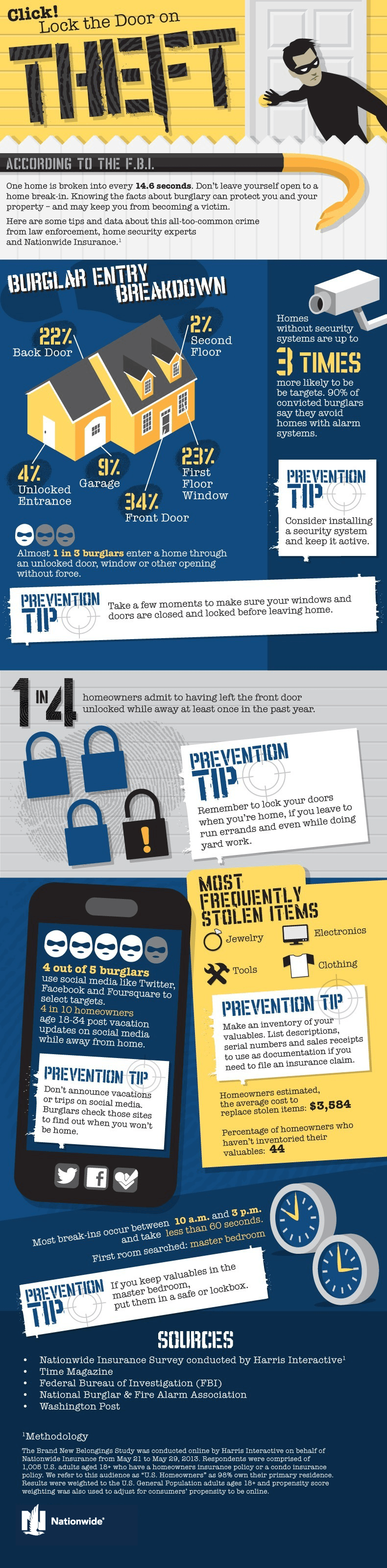
Lock the Door on Theft – Home Security Tips

Did you know that one home is broken into every 14.6 seconds? Home break-in crimes may be more common than you think, but taking certain precautions before you leave the house (and while you’re in it) can greatly reduce your risk of a burglary attempt. The infographic below shows a few surprising stats about break-ins and essential home safety tips and security information that can help you protect what’s important to you.

Lock the Door on Theft - Home Security Tips [Infographic]
Provided by Nationwide

Wednesday, August 16, 2017

Protect Your Home-Based Business with the Right Insurance

home business insurance
More than half of all U.S. businesses – 52% – are based in the home, according to the U.S. Census Bureau. A recent study commissioned by the Independent Insurance Agents & Brokers of America found that nearly 60% of home-based businesses do not have insurance coverage.
“When asked about the lack of insurance, nearly 40% of home-based business owners say they thought they were protected by some other type of coverage, while almost 30% say their businesses are too small to insure,” the IIABA said. “Notably, nearly 20% could not give a reason for not having insurance.”
Homeowners insurance covers incidents such as loss or theft of personal property. But if a delivery person slips and falls on your property or your business equipment is destroyed in a fire, homeowners insurance won’t protect you. Without coverage specifically designed for your home business, you put your livelihood, and possibly that of your employees, at risk. That’s why home-based business insurance is a good idea.

Choosing the right policy

No matter how small your home-based business, make sure you’re protected with the right coverage. There are three main property and liability options for home-based business insurance:
  • Homeowners policy endorsements: Adding an endorsement, also known as a rider, to your existing homeowners policy is often the simplest and most affordable way to insure smaller home businesses that don’t manufacture products on the premises or use a lot of equipment. Endorsements are also a good fit for solo entrepreneurs with few business-related visitors.
  • In-home business policy: Combining home and business insurance into a single plan, this type of policy offers more specific types of coverage. This policy is a step up from a basic homeowners policy endorsement, offering a greater range of coverage for a growing business. If your in-home business has developed into a mid-level operation with more visitors, equipment and output, this may be the policy for you. Such a policy may include more extensive property and liability coverage than endorsements, as well as business interruption coverage, which protects your income in the event your business is disrupted because of a disaster.
    Examples of what kinds of businesses would use this policy include a small baking operation that meets with clients in person and also does all baking, orders and shipping in-house; a clothing designer who fits clients, as well as manufactures and ships goods, from home or an accountant who makes regular in-person appointments and uses certain rooms in the house as dedicated office space.
  • Business owners policy: Often referred to as a BOP, this type of policy is the most comprehensive form of coverage for home-based businesses. It offers protection for claims brought by contractors, customers and employees, making it a good option for larger home-based businesses. It’s also the best fit for in-home businesses that operate in multiple locations or require extensive travel off-site.

Additional coverage

Whichever policy you consider best for the size and type of your business, be aware that you may need additional coverage not included in a standard plan. Here are some additional coverage options you may want to discuss with your insurance agent, if the plan you’re considering doesn’t include them:
  • Data compromise coverage: Helps protect you and your business from legal action stemming from a security breach that compromises confidential customer or client information.
  • Employment practices coverage: Protects against claims brought against you and your business by your employees.
  • Key person insurance: Basically life insurance on a person critical to the success of a business such as the owner, founder or a key employee, without whom the company might fail.
Most states require home-based businesses to purchase workers’ compensation insurance for employees, but purchasing this coverage is a smart move even if not mandated by law.
As you can see, in-home business insurance isn’t a one-size-fits-all consideration. Talk to a Nationwide agent about the best coverage for your home-based business.

Monday, July 24, 2017

How to Be a Friendly Neighbor

neighborhood etiquette
A plate of cookies can go a long way.
“Getting to know people is a peacemaking strategy,” says Laura Jeffords, an Asheville, N.C. community mediator who is on the board of the National Association for Community Mediation (NAFCM).

Starting off as a friendly neighbor

Making friendly overtures to newcomers sets the tone for your own relationship and can shape the culture of the entire neighborhood, says Jeffords, especially in changing or growing areas popular with families escaping cities, retirees seeking peace and quiet and longtime residents who expect to raise livestock or pets on their land.

Dialogue can help set neighborhood etiquette

People with different backgrounds, lifestyles and cultures often have different expectations about what it means to be a respectful, friendly neighbor, she says. Someone who wants to be left alone may not be happy to open the front door on Saturday morning and be faced with small talk from neighbors out for a walk. Conversely, newcomers seeking friends may misconstrue neighborly boundaries as standoffishness.
All of that is often unsaid, and that’s why conversations help defuse conflicts before they even start, says Jeffords. “The ultimate goal is for everyone to live peacefully in the neighborhood,” she says. A great conversation starter is to ask what the neighbor wants from living in the neighborhood. You can find mutual aspirations and bond over shared hopes.

Look over ordinances and rules

Review municipal ordinances and homeowners’ association rules to understand what’s OK before complaining. Homeowners’ associations regulations can dictate details right down to visitor parking and when it’s all right to water flowers. Municipal noise and nuisance ordinances usually outline what activities are allowed when. If your neighbor revs up the leaf blower at 8 a.m. on Saturdays, exactly when the law says he can, he’s perfectly within his rights.

How to approach a neighbor with a complaint

If a problem emerges, approach your neighbor with the expectation that you can easily work out a solution instead of expecting pushback. Jeffords says that a common problem of afternoon noise – from barking dogs, children playing outdoors or construction – can be disruptive to some.
Neighbors may not realize how disruptive the noise is for you. Explain the impact of the noise and ask how your families can arrive at a solution. Most people, are sympathetic and will offer a compromise, such as keeping a dog inside in the afternoon. After all, they’ll expect the same courtesy when they make requests of you. Common disputes, according to NAFCM records, include pets, pet noise, trash and traffic.
Jeffords’ tips for handling such disputes: Anticipate and try to mitigate the impact of traffic, congestion, parking and inconveniences if you run a home-based business that involves deliveries or a stream of clients to your house. Even regular meetings of a book club can cause difficulties if neighbors can’t easily get into their own driveways. Set rules and expectations for business operations and guests to minimize the impact on your neighbors.

Home improvement neighborhood etiquette

Home improvement projects inflict a heightened level of disruption, especially in city neighborhoods. Before your project starts, review neighborhood regulations and rules with the contractor. You might even draw up a courtesy sheet and ask the contractor to give it to all subcontractors so they know what disruptions are allowed, and when.
Clue your neighbors into the project schedule so they can plan accordingly.
Walk the project site daily and pick up debris that might end up in neighbors’ yards, especially important when they have pets or small children. When it’s all over, invite your patient neighbors over for an open house so they can see what all the fuss was about.

Find easy ways you can help your neighbors out

It’s always smart to turn your daily activities into an advantage for your neighbors. If you’re always catching the delivery van, offer to hold packages for neighbors with 9-to-5 jobs. If you’re nitpicky about your garden, offer to water your neighbors’ plants while they’re away for the weekend. If your neighbors are going to be away for an extended period, offer to look after their house. There are a few things a neighbor can do to help keep a house safe when the owners are away.
Having an open dialogue about neighborhood etiquette and offering a few friendly gestures can go a long way. That’s the kind of give-and-take that brings neighbors, and entire neighborhoods, together.

Tuesday, June 27, 2017

8 Tips for Finding a Good Contractor

how to find a contractor
Choosing the right contractor for your renovation or building project is one of the most important construction decisions you will make. A good contractor can ensure quality work and a smooth renovation, while the wrong one can trigger nightmares. Here are eight tips to help you make the right choice when hiring a contractor:

1. Have plans ready

Know exactly what you want in terms of plans and building materials before interviewing contractors. The more details you can provide, the more accurate their bid will be.

2. Get recommendations

Get recommendations from family and friends, local builders’ associations such as the National Association of the Remodeling Industry and your local Master Builders Association and from sites including Angie’s List. Although building inspectors may not give recommendations, they may tell you whether particular companies’ work generally passes initial inspections.

3. Interview candidates

Ensure candidates routinely build projects of the type and size you are proposing. Talk with three or four contractors about your project, expectations and timeframe. Learn how many projects they work on simultaneously, and get references and a list of recent projects. Also, ask how long they’ve worked with their subcontractors. Contractors should be willing to provide financial references from suppliers or banks.

4. Check licensing

Expect to see candidates’ state contractor’s license and certificate of insurance. Most states require contractors to have workers’ compensation, property damage and personal liability insurance. Check with the Better Business Bureau or your state consumer protection agency to learn whether contractors on your list have liens against them from former clients, suppliers or workers. An Internet search also may reveal valuable intelligence.

5. Visit job sites

Assess their crews’ work ethics for yourself, including how they treat others’ property. Do they minimize construction debris and dirt? Do they start work quickly or spend undue time on breaks?

6. Get bids

Have your top two or three candidates provide written bids for your project, based on the same specifications. Insist they categorize costs for materials, labor, profit and any other expenses. Common bid items are time and materials, fixed price and costs plus fixed fee. Expect materials to account for about 40% of the overall costs and profit to account for 15% to 20%. The lowest bid isn’t necessarily the best. If it’s significantly lower, that contractor may cut corners. If bids are comparable, choose the contractor with whom you best communicate.

7. Set a payment schedule

Payment plans vary according to project size. Expect to pay 10% of the estimated cost when the contract is signed and three payments of 25% evenly spaced throughout the project. The final payment should be made only after you are satisfied with the completed work.

8. Put the contract in writing

Incorporate every project detail in the contract. That includes: payment schedule, proof of liability insurance, workers’ compensation, start and finish dates, materials to be used, a lien release in case the contractor fails to pay suppliers or subcontractors and how changes will be handled.
If your top choice isn’t available, it might be a good sign. Usually the best contractors are busy, so be patient and be prepared to wait to start your project, with the right contractor.
Be sure to contact your Nationwide Insurance agent before you begin work and after your project is complete to ensure your homeowners policy will cover your project and any improvements you’ve made.

Wednesday, June 21, 2017

7 Tips to Prepare Your Home for a Storm

Preparing for a storm
While summer typically means warmer weather, it can also bring a variety of harsh weather conditions, sometimes leading to severe storms.
Homeowners can take preventative measures to help reduce damage if and when a severe storm hits. Ken Enscoe, senior director of Catastrophe Operations at Nationwide, shared some tips on how to help prepare your home:
  1. Clear limbs and trim trees: During a storm, dead tree limbs can get loose and cause damage to a home’s exterior or even puncture a window. Heavy rain can also cause trees with shallow root systems to pull out of the ground.
  2. Secure fences: Ensure that your fences are properly secured so to help prevent them from being lifted up and thrown against the house by heavy winds.
  3. Secure furniture: Heavy winds can cause items like patio furniture and large toys to damage the exterior of your home. It’s a good idea to anchor outdoor furniture or bring it indoors before a storm hits. You should also move anything in your yard that can become flying debris inside your house or garage.
  4. Check gutters: Help prevent damage inside your house by having downspouts drain away from your home and clear your gutters of any debris.
  5. Protect the critical areas: Wind is a major threat to your roof, windows, doors and garage doors. Either you or a building contractor can build and install temporary protection, such as approved wind shutters or plywood on windows and coverings for patio and entry doors, strengthen and stiffen garage doors, and install heavy-duty door hardware.
  6. Protect your valuables: Protect mementos in waterproof containers and/or take the items with you if you evacuate. Inventory valuables and contents in the home with pictures or video. Note the approximate value of each item and the date of purchase. You can also send an inventory to a family member outside your region for safekeeping. Also, make sure important documents, such as an insurance policy or mortgage papers, are stored in a safe deposit or fire safe box.
  7. Know your policy: It’s critical to read and understand your insurance policy. Then, examine your property to ensure there are no physical or liability hazards.
For more on how to prepare for a variety of severe weather situations, you can also visit the Insurance Institute for Better Homes & Safety website. 

Wednesday, March 1, 2017

8 Tips To Keep Your Family Safe From Heating Fires

Hey ya'll although the weather has been great lately I am sure we still have some cold Virginia days ahead.  I found this article about how to take care of your house and appliances to prevent house fires.  If you have ever known someone who has experienced a house fire, you know how terrible they can be.  Follow these easy tips to keep you family safe.  If you need to get your house insured give me a call!


Overall, heating equipment is the second leading cause of U.S. home fires and home fire deaths. There are between 350,000 and 400,000 house fires in the United States every year that result in almost $8 billion in annual damages, according to the National Fire Protection Association.

A heating fire can be catastrophic to a homeowner. Space heaters, fireplaces and water heaters are the biggest culprits but any type of heating element, including stoves and heating units, can cause fires.

Here are eight tips to keep you and your family safe from home heating fires this winter:

Inspect your furnace
Contact an HVAC professional to inspect your furnace and clean all the ducts. Remember to change your furnace filter each month during the winter and to remove all flammable material from the area around your furnace.

Clean your chimney
If you use your chimney a half-dozen times or more each year, it is a good idea to have it cleaned of soot and creosote every year. If you don’t want to hire a chimney sweep, consider a Creosote Sweeping Log, which can be bought at any home improvement store.

Check your chimney for structural damage
Make sure your chimney doesn’t have any cracks. If your chimney does have air leaks, it can change the flame in the fireplace and possibly ignite and cause a fire outside the fireplace.

Use a diffusion screen with your fireplace
A diffusion screen will prevent a flaming log from rolling out of the fireplace or sparks from popping out to cause a fire. If you have carpeting or wood flooring in front of your fireplace, it’s especially important to use a diffusion screen.

Be careful with space heaters
According to the U.S. Fire Administration, space heaters are involved in 74 percent of fire-related deaths. The best way to prevent a home fire caused by a space heater is to purchase one with an emergency cut-off so that it will automatically shut off if tipped over or accidentally knocked down. Otherwise, if it falls on the carpeting and doesn’t turn off, it could easily ignite a fire.
Never leave space heaters unattended. And make sure you place your heater on a flat, level, non-flammable surface such as ceramic tile rather than on a carpet. Don’t place space heaters near curtains, bedding or anything flammable, and make sure you are plugging the space heater into a GFI (Ground Fault Interrupter) system, so that if a malfunction does occur, the electricity will automatically turn off.

Check your water heater
As your water heater gets older, the thermostat and the heating element inside will start to deteriorate and the flame will become inconsistent. This could cause a flash fire, particularly if the water heater is in the garage where it is susceptible to wind or changes in air supply that could be caused by someone opening or closing a door.

Give your boiler a wide berth
Be careful not to put flammable items, such as boxes and newspapers, around your boiler system.

Don’t forget about the laundry room
Most homeowners don’t realize the laundry room can be a source of home fires due to the duct that connects to the back of the dryer and collects flammable lint. Homeowners should have their duct cleaned at least once a year. Your dryer doesn’t capture 100 percent of your lint and some of it ends up in the ducts, and that material is very flammable. If you have enough dryer lint built up in the duct you can have a huge fire.

Friday, February 17, 2017

Staging a House For Sale


Staging a House for Sale: 11 Tips from the Experts


Photo courtesy of Nationwide

Nationwide Blog Original Article 

Homeowners looking to get the best price for their home are learning that if you want to sell quickly and score big profits, you need to remove clutter and make the place look inviting, not lived in.

Staging your house can help you sell it faster and possibly bring you more money, say many real estate professionals. The cost to stage a home is typically less than 1 percent of the list price, says Cindy May Davis, a Realtor with the Ann Wilson Homes Team for Keller Williams Realty in Arlington, Va., and the return is typically 1 percent to 5 percent over the list price.

Homeowners can hire a staging company, work with a real estate agency that does the staging for its clients or do it themselves. Here are 11 tips for staging your home that will have a positive impact on its price and appeal:

1. Give your home curb appeal

Most buyers start their home search on the Internet. Often their first impression of your home is a photo of the outside, Davis says. Before you take that photo, be sure you have spruced up the grounds of the house by weeding, mulching, trimming back trees and bushes, and power washing your siding and walkways.

2. Depersonalize and declutter

When buyers come into your house, it’s important they be able to visualize themselves living there, Davis says. So take down anything personal, including family photos, collections, diplomas or awards, , replacing them with generic artwork and photos. “This is often the hardest thing for people do to,” she says.

3. Clean your house

Make your house shine by cleaning everything including the inside of your appliances, the baseboards and windows, Davis says. Change your air filters and clean out your gutters. “This will show buyers that you do regular maintenance on the house,” she says.

4. Get rid of odors

If you’re a smoker or have a pet, it’s important to get rid of odors. Be careful of using air fresheners, Davis warns, because many are too strong and they might suggest you are trying to hide something. Open the windows instead.

5. Neutralize colors

Potential homebuyers might not love the dark purple accent wall in the dining room as much as you do, so it’s best to paint the walls a neutral color before you start showing the house, Davis says. You don’t have to paint every wall white but it should be a neutral color that will appeal to a variety of people.

6. Turn up the lights

At every open house, Davis opens every blind and curtain to get let in as much light as possible. If a room seems too dark or the lamp is outdated, Davis says she will bring extra lighting or a new lamp to the open house. Make sure all the light bulbs in your house are working on the day of the open house.

7. Pare down furnishings

Oversized furniture can make a room feel smaller, Davis says. Furniture is there to help the buyer visualize what the room is used for, but it’s best to minimize the number of pieces so the buyer can envision their own furniture in the room.

8. Accessorize

After you remove all the clutter add some accents such as interesting coffee table books, throw pillows and blankets on the sofa, a bowl of fresh fruit on the kitchen counter and matching towels in the bathroom.

9. Make repairs

If there is anything that clearly needs to be repaired or if there are any unfinished projects, you need to take care of them before the open house. No potential buyer wants to see unfinished work inside the house.

10. Clean out the closets and drawers

Potential buyers will open every closet, cabinet, drawer and door, says Davis, and you will want to display as much storage as possible. Davis recommends using baskets to hold items that are normally just loose in drawers and in closets to make them look less cluttered. She also tells clients to remove 20 percent to 30 percent of what is inside each closet to show space between items that are hanging up. This will make the closet seem larger.

11. Check the floors

If the carpeting is stained, replace it. If you’re using an old area rug, remove it. If your wooden floors are scratched, cover them with inexpensive area rugs.

Staging a home is key to appealing to prospective buyers. Get more helpful information about selling your own home today.
Monday, November 21, 2016

Need to save a little money for the Holidays?! Energy efficiency may be one of the ways to do it!

7 Ways to Stop Drafts in Your Home


Drafts, or air leaks, can come into your home through windows, fireplaces and even electrical outlets, making your house feel several degrees colder and driving up your heating bills. The potential energy savings from reducing drafts can range from 5% to 30% per year, according to the U.S. Department of Energy.

Here are seven ways to find and fix drafts in your home before winter’s frigid temperatures hit.


Windows and doors


Most people automatically think to check for gaps around their windows and doors, and many will opt to use self-sticking weather stripping or a decorative draft stopper to stop air leakage. Others will caulk around their doors and windows. Caulking, however, isn’t as easy as it sounds.
“Caulking seems easy until it’s coming out of the end of the tube and you can’t control it, it goes all over the place and it doesn’t go where you want it to go,” says Mark Clement, co-host of a home improvement radio show. The problem, he says, is there are so many different types of caulking to choose from. The best choice is to use a high-quality latex caulk that cleans up with water.
You should also check for cracked caulking around your doors and windows. If you find any cracks, you will need to re-caulk those areas to prevent cold air from seeping in. If you want to add an extra barrier between the outside air and your home, you could also install an insulating plastic film over your windows to provide an airtight seal.

An easy way to stop air leakage, says Clement, is to lock your windows. Sometimes a window will look closed but, until it is locked, it’s hard to tell if the window is shut tight, he says. If you can’t lock your window, try opening it all the way and closing it again to make sure the window is still on its track. If that doesn’t work, you might need to call a professional to check your window.


Floors


If you have an unfinished basement, there is a good chance your floors feel cold when you walk around in bare feet and even when you wear socks, Clement says. The best way to stop cold air from penetrating the floor is to add insulation under the flooring.


Cable lines and wires


Anywhere a cable, wire or pipe goes from inside to out, there is typically an air leak. If the hole around the wire or pipe is a quarter of an inch or less, you can use caulk to seal it, Clement says. If it is larger, use foam insulation to close the hole.


Electrical devices


Contractors often under-insulate light switches and plugs, says Clement. As a result, they can become wind tunnels. If you remove the electrical wall plate around your light switch or plug, you may see a gap between the device and the wall. You can fill up the cavity with low-expanding foam insulation. This video explains how to do it (but when in doubt, consult a professional).


Attics


Make sure your attic is properly insulated. It’s important to seal areas where exhaust fans, attic stairs and small holes allow cool air to seep into your home. Foam insulation and weather stripping can be added to the plywood or drywall in your attic to help seal up those areas.


Fireplaces


The damper inside your chimney is meant to keep the cold air out but since dampers are typically made of cast iron, they don’t entirely keep the cold away. One way to stop drafts from fireplaces is to insert a piece of thick foam insulation covered with decorative fabric at the fireplace opening when you aren’t using the fireplace.


Buffer your home with landscaping


Shrubs and trees planted around your home can help protect it from the wind in the winter and provide shade in the summer. For instance, says Clement, if you plant an evergreen tree in front of your house it will protect your home from the wind, keeping the cold air from hitting your house and windows directly.

Tuesday, November 15, 2016

5 Tips for Windshield Crack Prevention and Repair

5 Tips for Windshield Crack Prevention and Repair


All it takes is one small chip in the windshield before it becomes a full-fledged crack. Small yes, but you want to be safe. Here’s how to prevent a windshield crack from interfering with your safety.

1. Decide if it needs immediate attention

First, where’s the crack located? Is it off to the side or is it obscuring your view? If it interferes with your ability to see the road, you should deal with even a small crack immediately by taking your car to the repair shop. However, if it’s not really impairing your ability to see the road, grab a ruler.

2. Determine whether it needs repaired or replaced

If the crack is less than 12 inches long, or the chip is smaller than the size of a quarter, the integrity of the windshield hasn’t been compromised and probably doesn’t require replacing, according to Cars.com. But every crack or chip is different, and it’s important to consult an expert. The goal is to ensure a crack from getting bigger or in any way compromising safety.

3. Avoid dirt and debris

One of the biggest things to guard against is dirt. If dirt gets into the crack, it can make a simple repair much more complicated. But that doesn’t mean you should head for the car wash or reach for a bucket. If water seeps into the crack, what began as a small repair has now become a complete replacement. Instead, keep dirt and moisture away from the crack with a piece of clear packing tape, which is strong but won’t obscure your view.

4. Park indoors to avoid the sun

If possible, park the car inside, where it will be protected against rain as well as the sun, which can cause the windshield to heat up and allow the crack to expand. If you don’t have a garage, try parking in a shaded spot.

5. Avoid temperature extremes

Likewise, keep in mind that extreme cold is not good for the cracked windshield. Refrain from putting your air conditioner or defroster on high. If necessary, use the heater moderately to gradually defrost the windows.

6. Drive carefully

Another way to keep the crack from getting larger is to drive with extra caution. That means steering clear of potholes and staying away from rough roads. Jostling the car is the last thing that you need when driving with a crack, and you also want to be careful when getting in and out of the car and avoid slamming the doors or the trunk.
Above all, keep safety in mind at all times; the sooner you get the windshield in for replacement or repair, the better. Beyond repairing a cracked windshield, performing regular car maintenance is key to sustaining your car in the long term. Check out the ultimate car maintenance schedule and keep your ride up to date.