Showing posts with label best insurance agents in richmond. Show all posts

Friday, February 16, 2018

4 Easy Tips to Declutter Your House

declutter your home

Are you looking to declutter your life? The best place to start is with your home.
Piles of stuff can make you feel boxed in, and purging your house of unnecessary objects can improve your outlook and make it easier to enjoy spending time around the house, whether you just a neater space or are in the process of downsizing. But decluttering a home can feel daunting unless you have a plan.
You may want to tackle small tasks first, build a sense of accomplishment and then move on to bigger projects. You may even want to set several goals. Whatever you decide, here are four ways to get started on decluttering.

1. Use a four-bin system

To start eliminating clutter, go through your home room by room with four bins: keep, toss, donate and store. In the “keep” bin you’ll put items you want to keep but need to put in a new place. The “toss” bin goes to the garbage, the “donate” bin receives items other people can use and the “store” bin is for those things that you don’t use frequently but want to keep.

2. Clear flat surfaces in the kitchen

Clear off flat surfaces in your kitchen, including your countertops, tables and more obscure spots like the top of your refrigerator and microwave.
You’ll want to remove everything that you don’t use on a daily basis. File the pile of bills and other papers. Consider placing a toaster you use once a month in a cupboard and paring down the dozen cookbooks you’ve been keeping on top of the refrigerator to just your favorites.

3. Declutter bedroom closets

Bedroom closets tend to be a catchall. Many people toss what they don’t need or don’t have time to hang up into their closets. Take some time to organize and determine what you no longer wear or use.
One possible strategy: Remove everything from your closet shelves, wipe them down and then make decisions about what to do with various objects before you start replacing things.
If you haven’t worn something in your closet for a year or more, consider placing it in the Donate bin. Be decisive, but don’t be afraid to hang on to a few key sentimental pieces if they mean a lot to you, either.
4. Free the entryway
When you first walk into your home, do you trip on a pile of shoes? Are dozens of coats piled on a table? If your entryway is cluttered, it makes your house feel unkempt. Coat and shoe racks can solve this problem. You might also make a rule to limit shoes and coats to those needed for a season, the rest can be stored away too.
If you’re decluttering in a hurry, be sure to check out these quick house cleaning tips.
When your home is decluttered, it’s even easier to enjoy spending time in this peaceful, relaxing space. Find a homeowners insurance policy that’s tailored to your unique needs to increase your peace of mind even further.

Monday, February 12, 2018

Sharing Finances After Marriage


sharing finances


When couples marry, they typically combine a number of things – their belongings, their families and, often, their finances. While money ranks high on the list of things couples fight about most, experts say there are healthy ways to resolve – and even prevent – financial disagreements.
Much of the problem couples have with money comes from the fact that most of us are raised not to talk about money, according to the American Psychological Association. The association’s 2014 study, “Stress in America,” found 31% of couples said money is a major source of conflict in their marriage. What’s more, according to the APA, those conversations tend to be more heated than other touchy topics that couples experience.
Like many beliefs, our thoughts about money are developed early on and they’re largely inherited from our parents and the way we were raised. In the study “Predictors of Belief About Money,” researchers found these beliefs about money might be so ingrained in us that we don’t consciously recognize all of them even though they will affect how we act toward money as well as how we interact with our spouses.

Something to talk about

When couples begin dating, they often talk about career goals, beliefs about how to raise children and where they want to live. But in most cases they do not discuss their views on spending and saving or explore their attitudes toward money.
The APA says it’s important to talk about each other’s “money history” to become more aware of what the other person believes and to become more aware of their own perspectives on finances.
According to the APA, these are good questions for couples to ask one another to begin the discussion about their personal financial beliefs:
  • What did your parents teach you about money?
  • What are your financial goals?
  • What are your fears about money?
From there, couples can also begin talking about what they’d like to accomplish together as a couple and begin defining what is important to achieve. Like most aspects of a relationship, it will take work and compromise – but discussing and planning it will inevitably be more successful than not talking about it and then fighting later.
Couples may also want to discuss the attitudes toward money they want to eventually instill in their children. What do you want them to learn about spending and saving? How will you shape their views of the value of money? Ideally, both partners should approach the matter consciously and take an active role in defining their family’s view of finances for the future.

When opposites attract

If two partners find that they have very different views about money, there are still plenty of ways to make a relationship work without having money as an ongoing dispute.
Talking about your views on money as a couple can help each person view the situation through the other person’s eyes and should help make communications about money more open and empathetic. You can establish guidelines for spending and saving that both of you are comfortable with.
Remember, this should be a negotiation, not a hostage situation, and it’s something you agree on together. That way, each person feels like they are being heard and they have a chance to create a budget or spending plan that works with both styles.
If you merged or are considering merging your finances with your partner, talk to a Nationwide financial advisor who can help you plan for the future.

Friday, February 2, 2018

FIRE & BURNS: HOME FIRE DRILL

HAVE YOU PRACTICED WITH YOUR FAMILY?
  

Get out your stopwatches, because it’s time for a two-minute home fire drill. Home fires are more common than many parents realize, but only a fraction of families have an escape plan. Visit HomeFireDrillDay.com to learn fun and memorable ways to teach kids how to escape a home fire in an emergency.

STEPS TO SAFETY


MAKE A PLAN

Draw a floor plan for each floor of your home, including windows and doors. For each room, find two ways out, and label them on your plan. Get started by downloading the worksheet.
Designate one adult to help get babies, young children, or family members who need extra help out safely. Have a back-up plan in case the primary person is overcome by smoke, or is not home.
Decide on a safe meeting place for your family. Make sure it is a safe distance away from the home.

TALK TO YOUR KIDS

Make sure everyone knows what to do and where to go in case of a fire.
Test your smoke alarms once a month, and make sure your child can recognize the sound.
Teach your child to get low and crawl on the ground, where the air is less smoky.
Show your child how to use the back of his hand to check doors for heat before opening. Teach them to use a different way out if the door is hot to the touch.
If your child needs to use an escape ladder, show him where you keep it, and how to use it.
Children can become scared and confused during emergencies, so teach them to never hide from firefighters.
Teach children to NEVER go back inside a burning building. Once they are out, stay out!

DO A HOME FIRE DRILL

Practice your fire escape plan twice a year. Fires can start anywhere in the home and at any time, so run through the plan at different times of the day or night, and practice different ways out.
Use a stopwatch to time how fast everyone can get out and to the specified meeting place. The goal should be under 2 minutes.
Practice feeling the door and doorknob with the back of your hand for heat.
Explain that if they do catch fire, they need to stop, drop and roll.


Friday, January 26, 2018

7 Ways to Teach Kids How to Save Money


Starting early can make a world of difference when it comes to teaching children to save and make sound financial decisions.
Luckily, there are simple ways to teach kids about money and help youngsters learn smart saving techniques. Here are some approaches to teaching children the valuable art of saving.

1. Teach kids about money with actual money 

In a world where anything can be purchased with the swipe of a card or typing of a password, the simple reality of cash can help teach the value of a dollar. That’s why using physical currency can be a smart way to teach kids about money. Counting coins and bills can also help preschoolers with hand-eye coordination and math skills.

2. Give an allowance

Giving children their own money is a good way to start teaching them how to save. Kindergarten is a great age to start a weekly or monthly allowance. A good rule of thumb is to pay $1 for every year of their age, so the incentive grows as they do. Make sure the allowance is based on completed chores, though. That way, kids understand that money is earned.

3. See the savings

Using a clear container as a bank can help give kids a sense of accomplishment watching the coins and dollars stack up. Make goals visible by marking a line on the side of the container as a target to reach. Not only does this teach children about saving, it makes reaching goals exciting and fun!

4. Teach children to allocate their savings

To introduce money management, as well as delayed gratification and charity, encourage your child to divide their money into three piles: savings, spending and sharing. You can do this online with the website Threejars.com, where kids can track their earned allowance and even earn interest on savings.

5. Set saving goals

Help your child develop savings targets to make sure savings isn’t an open-ended concept. The first goals should be reachable, fun and defined by both the parent and child. Sure, it may seem silly to save for a small toy, but the sense of achievement is worth it.

6. Teach kids about saving money in a bank account

As your child matures and has accumulated at least $100 in long-term savings, look into a bank savings account. Most major banks offer children’s savings accounts that can be opened online or at a local branch. A trip to the bank may be a new and fascinating experience for your child, inspiring a sense of maturity and financial responsibility. It’s also a great time to teach kids about other money concepts, like interest and risk.

7. Have conversations about saving

The best tool for money management is conversation. Parents should talk to their kids about money matters like budgeting and investing. Aim to mirror good money behaviors, but remember it’s also okay to admit to your own money mistakes.
Show your kids what smart money management is. Visit Nationwide Bank for information on banking, investing and more.

Wednesday, January 24, 2018

How to Negotiate Your Rent

woman negotiating her rent with landlord

Whether you’re apartment hunting and the perfect place is slightly out of your price range, or your landlord is raising the rent on your current apartment, you have the option to try and negotiate your rent. It sounds intimidating, but with a little strategy, you just might win over the landlord. Here are some ways you can go about negotiating your rent price:

Ask the landlord if rent price is open to discussion

Politely ask if the landlord is willing to discuss rent prices and when a good time to talk would be. If you’re negotiating price for a new place, it’s important to know who you are talking to. A large property company is less likely to negotiate terms, while an independent landlord has more leeway to change prices.
If you’re facing a rent increase, start the conversation at least a month before your lease ends so your landlord has enough time to consider your offer or, if need be, you have time to make other plans.

Highlight your strengths as a tenant

If you’re looking for a new place, you can show you’re financially stable by offering the landlord a few concessions, such as paying a few months of rent in advance or signing on for a longer lease which saves the landlord money in turnover.
In the case of a rent increase, you should remind the landlord what a reliable, responsible tenant you’ve been. If you’ve always paid your rent on time, are courteous to other tenants and have kept the property in good shape, make sure your landlord knows it. It can help prove your worthiness and give them an incentive to keep your current rent.

Inquire about extending the lease

Showing that you plan to stay in your apartment for a substantial length of time can demonstrate that you’re a stable investment. If the lease is annual, offer to extend it to 18-24 months in exchange for keeping your current rent. If the landlord knows he or she won’t have to take a risk with a new tenant, this could be a good compromise.

Offer to end the lease in the summer

Landlords know the summer is usually an easier time to find tenants. Since most people have more flexible schedules then, such as recently graduated college students looking for first apartments, there are simply more people looking for rental spaces. Offering to end your lease in the summer can be an attractive option for a landlord, and they might be willing to shave prices in exchange for the convenient end date.

Research the property’s value

Consider if the is rent beyond the actual worth of the prevailing market. Research rent rates by talking to other landlords or neighbors in the area. Knowing average property prices and frequency of rent hikes in the neighborhood may give you leverage.

Be open to compromise

Unless you’re simply unwilling or unable to afford the rent rate, suggest a compromise amount that you can afford. For instance, if the rent is $100 higher than you’d like, offer to pay $50 instead. Back up your offer by mentioning your research findings and focusing on your stability as a tenant.

Negotiate in person, follow up in writing

Try to talk to the landlord in person as face to face negotiation is usually best. Remain calm, polite and professional during the discussion – never rude or defensive. Follow up the discussion within 24 hours with a brief email thanking them for the meeting and reiterating your “ask.”

Have a backup plan

If you’re looking for a new place, you should have more than one apartment, house or condo on your radar. Banking on a landlord decreasing rent prices can be risky, especially if you have a set date you need to move out of your old place.
If you’re facing a rent increase, you have to decide if you’d be willing to pay the higher rate just in case negotiations don’t go as planned. If you are definitely unwilling or unable to accept the new rate, it’s a good idea to start researching new apartments. If you decide to stay and pay more each month, you can request property upgrades to make the increase more palatable, such as repainting the walls or updating the landscaping.

Rent increases aren’t the only unexpected thing that can happen to renters. Find out how Nationwide renters insurance can protect you against theft, damage to personal belongings, and more.

Friday, August 4, 2017

Checklist for Apartment Hunting

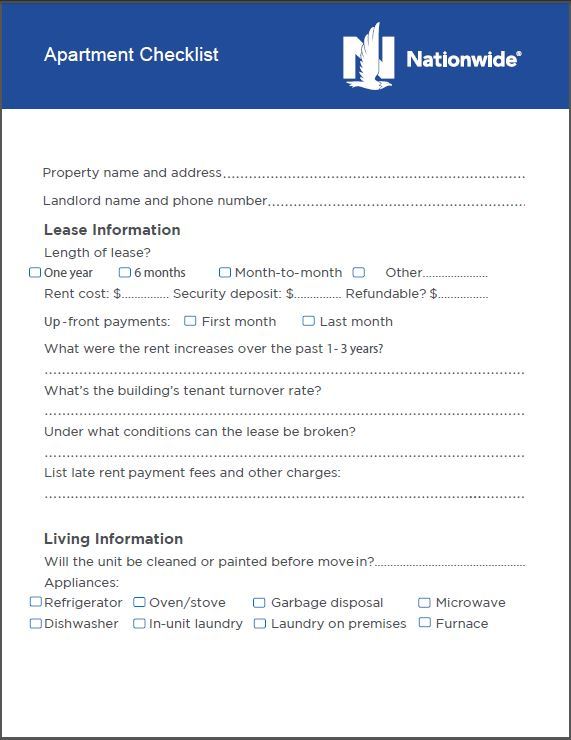
We’ve all heard horror stories of pest infestations, basement flooding, broken fixtures and neglectful landlords. And while some apartment problems are difficult to anticipate, many can be avoided with the right apartment hunting questions – if you remember to ask before signing a lease.
When viewing an apartment, there’s a lot to process in a short time. It’s easy to forget to check the laundry room, or ask whether the building allows pets. That’s where a checklist can come in handy. Print out the apartment hunting checklist below before your next apartment viewing to help keep track of the questions that matter. If you don’t see a question that should be there, add it to the back and don’t be afraid to ask while viewing apartments.

Download the Apartment Hunting Checklist


Apartment Checklist
Click to download

Is there anything that would be on your apartment hunting checklist that we missed? And do you have an apartment horror story of your own that could have been avoided by asking the right apartment hunting questions? Let us know in the comments.
Don’t forget to protect yourself from the unexpected. If you live in a rented apartment, condo or home, be sure to take a look at renters insurance. You can feel at ease by safeguarding your belongings in the event of theft, weather damage and much more with a customizable policy.

Tuesday, June 27, 2017

8 Tips for Finding a Good Contractor

how to find a contractor
Choosing the right contractor for your renovation or building project is one of the most important construction decisions you will make. A good contractor can ensure quality work and a smooth renovation, while the wrong one can trigger nightmares. Here are eight tips to help you make the right choice when hiring a contractor:

1. Have plans ready

Know exactly what you want in terms of plans and building materials before interviewing contractors. The more details you can provide, the more accurate their bid will be.

2. Get recommendations

Get recommendations from family and friends, local builders’ associations such as the National Association of the Remodeling Industry and your local Master Builders Association and from sites including Angie’s List. Although building inspectors may not give recommendations, they may tell you whether particular companies’ work generally passes initial inspections.

3. Interview candidates

Ensure candidates routinely build projects of the type and size you are proposing. Talk with three or four contractors about your project, expectations and timeframe. Learn how many projects they work on simultaneously, and get references and a list of recent projects. Also, ask how long they’ve worked with their subcontractors. Contractors should be willing to provide financial references from suppliers or banks.

4. Check licensing

Expect to see candidates’ state contractor’s license and certificate of insurance. Most states require contractors to have workers’ compensation, property damage and personal liability insurance. Check with the Better Business Bureau or your state consumer protection agency to learn whether contractors on your list have liens against them from former clients, suppliers or workers. An Internet search also may reveal valuable intelligence.

5. Visit job sites

Assess their crews’ work ethics for yourself, including how they treat others’ property. Do they minimize construction debris and dirt? Do they start work quickly or spend undue time on breaks?

6. Get bids

Have your top two or three candidates provide written bids for your project, based on the same specifications. Insist they categorize costs for materials, labor, profit and any other expenses. Common bid items are time and materials, fixed price and costs plus fixed fee. Expect materials to account for about 40% of the overall costs and profit to account for 15% to 20%. The lowest bid isn’t necessarily the best. If it’s significantly lower, that contractor may cut corners. If bids are comparable, choose the contractor with whom you best communicate.

7. Set a payment schedule

Payment plans vary according to project size. Expect to pay 10% of the estimated cost when the contract is signed and three payments of 25% evenly spaced throughout the project. The final payment should be made only after you are satisfied with the completed work.

8. Put the contract in writing

Incorporate every project detail in the contract. That includes: payment schedule, proof of liability insurance, workers’ compensation, start and finish dates, materials to be used, a lien release in case the contractor fails to pay suppliers or subcontractors and how changes will be handled.
If your top choice isn’t available, it might be a good sign. Usually the best contractors are busy, so be patient and be prepared to wait to start your project, with the right contractor.
Be sure to contact your Nationwide Insurance agent before you begin work and after your project is complete to ensure your homeowners policy will cover your project and any improvements you’ve made.

Thursday, May 18, 2017

How to Make a Small Business Website: 9 Tips for Success


It’s not enough nowadays to throw open the doors of your brick-and-mortar location. It’s important to have a website as well. Too many small businesses neglect this aspect of their marketing. The Service Corp of Retired Executives (Score) reports that a mere 51%  of such companies have their own websites. Meanwhile, customers are busy scouring the Internet for goods and services, with over 97% performing online searches for what they need.
Where’s a business owner to start? The process doesn’t need to be daunting. Here are nine easy steps to making a small business website:


1. Play the name game

Like parents choosing a lifetime moniker for their child, be selective in choosing a domain name. You want customers to remember it easily and even to think it’s clever. But you don’t want to be inappropriate. Do not use words or word combinations that might be deemed vulgar, insulting or mean-spirited. If you have doubts, tone down the name or change. A domain name is a key part of branding. You want to get it right.


2. Kiss website clutter goodbye

This is not the time to show off your computer acumen, with lots of distracting sounds and lights on the site and every icon known to web-kind. You want to keep it simple and make it easy for customers to discover what you’re all about while navigating the site.


3. Introduce yourself in your “about us” page

Metaphorically look potential customers in the eye, tell them how you came to start your business and what it means to you. Let them become invested in your story and want to reach out to you for what they need.


4. Make contact easy

Let customers know where you’re located and how they can get in touch. Put your business ‘contact information some place customers can’t miss, such as the top left or right corner on each page. You may also want to include a Google map to your location to put your locale in context.


5. Broadcast business hours

Before people run out to pick something up, they want to know that you will be there. Just as you would have your hours posted on your door, have it on the site as well.


6. Be mobile friendly

This means making sure your webpage loads easily onto smart phones. While customers rely on these more and more, 90% of small business websites don’t keep the smaller mobile device’s screen size in mind when they create their sites, making it difficult for some customers to view.


7. Build trust

Include testimonials and reviews from customers. Many customers feel more comfortable purchasing a product that others like. Even if you have just one testimonial, shine a spotlight on it. You may also want to link to other review sites where your product has been featured.


8. Ask for the business

This is not a time to be coy. Explain what you want people to do. Use terms such as, “Make your reservation now” or “Call us for a free quote today.”


9. Keep people coming back

Include information that changes on a regular basis such as a blog or newsletter on which customers come to rely.
Building a successful small business website is a huge step towards launching your small business. If you’re trying to get a small business off the ground, make sure you don’t make these 5 common small business mistakes.